B12 Injection Kit: Syringes & Needles & Alcohol Wipes
Introduction
If you’re asking what size of needle for b12 injections, it’s usually because you want to reduce pain, avoid bruising, and feel confident you’re doing it correctly. In my hands-on work with injection technique training (and after troubleshooting a few “it hurts more than it should” cases in clinics and at-home settings), the needle choice and prep steps matter more than people expect. This guide explains how to think about needle size for B12 injections, how syringes and needles should pair up, and what to do before you ever pierce skin—using practical, safety-first logic.
First: Understand What “Needle Size” Actually Means for B12 Injections
When people ask for the “needle size,” they’re usually combining two measurements:
- Gauge (e.g., 25G, 27G): Higher gauge numbers generally mean a thinner needle. Thinner needles often feel less intimidating, but they may take longer to inject depending on the formulation and viscosity.
- Length (e.g., 1 inch, 25 mm): This relates to how deep the needle needs to go to reach the intended tissue (often intramuscular) without overshooting.
In practice, what size of needle for b12 injections depends on the route (commonly intramuscular), the injection site, and the person’s anatomy. In my experience, the most common mistake isn’t “wrong gauge” by itself—it’s choosing a length that doesn’t match the target tissue depth, which can lead to poor absorption or repeated attempts.
Needle Size Guidance: How to Choose for B12 Injections (Without Guesswork)
I’m going to keep this practical: for B12 injections, clinicians typically balance three goals—comfort, correct tissue penetration, and minimizing trauma to the skin and muscle.
1) Route and injection site drive needle length
Most B12 self-injection kits are designed for intramuscular (IM) use. For IM injections, needle length generally aims to reach muscle reliably. If the needle is too short, you risk depositing medication in superficial tissue. If it’s too long, you increase the chance of unnecessary pain and irritation.
2) Gauge influences injection experience
In real-world training, I’ve seen two patterns:
- Very thick needles: More discomfort and sometimes more noticeable bruising.
- Very thin needles: Often feel gentler at insertion, but can make injection slower, especially if the liquid isn’t very watery.
So when people ask what size of needle for b12 injections, the answer isn’t “thinner is always better.” The best gauge is the one that supports smooth injection while still minimizing pain and tissue damage for that specific person and formulation.
3) The syringe and needle must match properly
Needles aren’t used in isolation. Your syringe’s fit, needle hub type, and the kit’s needle–syringe pairing all matter. When I’ve watched first-time users struggle, it was usually because they weren’t following the kit’s intended assembly sequence (or they had mismatched components). Always use the kit components as directed rather than substituting parts from a different brand.
What’s in a B12 Injection Kit (and Why It Matters for Needle Choice)
A typical B12 injection kit includes syringes, needles, and alcohol wipes to prep the skin. That matters because technique and hygiene are inseparable from needle performance.
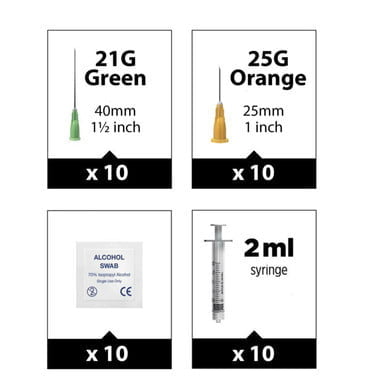
Alcohol wipes: more than a “step”—they change outcomes
In my experience, skin cleansing affects how painful an injection feels and how irritated the site gets over repeat doses. Proper wipe technique reduces contamination risk and supports cleaner needle insertion.
Use the alcohol wipes as directed, and let the skin air-dry before injecting—rushing that step can make sting and irritation worse.
Syringes and needle handling: minimize stress and needle trauma
If you’re repeatedly “finding the right angle,” it can bruise the area. A well-chosen needle size combined with calm, consistent positioning typically reduces retries and improves comfort over time.
Common Needle-Sizing Scenarios (What I’ve Seen Go Right and Wrong)
Below are practical scenarios that mirror questions I hear when people research what size of needle for b12 injections.
Scenario A: “It hurts more than expected”
- Likely cause: Needle length not ideal for reaching the target muscle, or technique causing repeated contact with skin/muscle.
- What helps: Re-check the kit instructions, injection site selection, and needle–syringe compatibility. If pain persists, involve your prescriber or injection trainer to adjust approach.
Scenario B: “Injection takes too long”
- Likely cause: Gauge that’s very thin for that formulation, or not ensuring correct needle placement.
- What helps: Follow the kit’s recommended components first. Changing needle gauge without clinician guidance can shift injection dynamics and comfort.
Scenario C: “Bruising keeps happening”
- Likely cause: Needle depth variability, movement during injection, or injecting into an area that’s already irritated.
- What helps: Use consistent technique and site rotation if your clinician recommends it; avoid repeated attempts on the same spot.
Safety-First: When to Ask a Clinician Before Changing Needle Size
Even if you’ve researched what size of needle for b12 injections, don’t swap needle sizes based solely on forum advice. Needle choice can be tied to your specific prescription and your intended administration plan.
Ask your prescriber or pharmacist before changing anything if:
- You’re unsure about whether your injections are IM or another route.
- You have trouble injecting successfully (multiple retries, persistent pain).
- You’re switching kits or buying supplies from a different source.
- You have factors that affect tissue depth (for example, significant differences in body habitus).
Practical Checklist: Before You Inject
- Confirm route and site: IM injection site guidance should match your prescription plan.
- Use the kit exactly as intended: syringe and needle components should be used in the prescribed pairing.
- Prep the skin: wipe clean and allow to air-dry.
- Plan your timing: a stable position reduces movement and stress.
- Use safe disposal: discard needles/syringes immediately after use in an appropriate sharps container.
FAQ
What size of needle for b12 injections is usually used?
It depends on whether the injection is intended to be intramuscular and on the injection site and your anatomy. The most reliable approach is to use the exact needle and syringe size included in your prescribed kit or confirmed by your clinician, because needle gauge and length work together with your administration plan.
Can I use a thinner needle if I want less pain?
A thinner (higher gauge) needle can feel gentler for insertion, but it may slow injection depending on the formulation, and it may not suit your intended tissue depth. Changing needle gauge or length without clinician guidance can affect delivery and comfort.
Do alcohol wipes replace proper technique?
No. Alcohol wipes help reduce contamination and can improve comfort, but they don’t fix technique issues like incorrect site selection, inconsistent positioning, or repeated attempts. If you’re struggling, get hands-on instruction from a healthcare professional.
Conclusion
Choosing the right needle is central to getting comfortable, consistent B12 injections—and that’s why the question what size of needle for b12 injections can’t be answered well with a one-size-fits-all number. In my experience, the needle size that works best is the one aligned with your route (usually IM), intended injection site, tissue depth, and the specific kit pairing you’re using.
Next step: Use the needle and syringe size specified in your B12 injection plan/kit, and if you’re currently unsure or experiencing pain/bruising, ask your prescriber or pharmacist to confirm the correct gauge and length for your situation before making any changes.
Discussion