Bpc 157 Human Clinical Trials BPC-157 and the Difference Between an Evidence Gap and a Cover-Up: What the entire human evidence base actually looks like, and the questions to ask next. — WellFounded
Introduction: When “human evidence” sounds definitive—but doesn’t
If you’ve ever searched for bpc 157 human clinical trials and felt whiplash—one page implying it’s well-established, another insisting the evidence is thin—you’re not alone. In my hands-on work reviewing biomedical claims (for content strategy and risk-aware messaging), the most common pattern I see is this: people treat an evidence gap as if it were a cover-up, or they assume the absence of trials means something sinister. The reality is usually more mundane—and more important to get right.
This article breaks down what the “entire human evidence base” for BPC-157 actually looks like in practical terms, how to distinguish an evidence gap from a cover-up, and the questions you can ask next to evaluate any future study claims. I’ll keep the focus on humans and on what decision-makers can reasonably conclude today.
First, define the terms: Evidence gap vs. cover-up
Before you weigh the credibility of any claim about BPC-157, it helps to name what you’re actually looking at. Two ideas get conflated online:
What an evidence gap looks like
An evidence gap typically means: we have limited or indirect human data relative to how often the compound is marketed or discussed. The gap can exist for several non-conspiratorial reasons—funding priorities, regulatory hurdles, sponsor risk tolerance, or simply the time it takes to run adequately controlled trials.
In content reviews, I look for evidence that the gap is being actively narrowed—e.g., ongoing trials registered in credible databases, published protocols, or multi-site study designs. When none of that is visible, you’re still likely in “gap territory,” not “cover-up territory.”
What a cover-up would require to be plausible
A credible “cover-up” narrative would need something concrete: consistent evidence that trials were completed, results were withheld, and there’s reliable documentation of suppression by independent sources. In practice, those claims are extraordinarily hard to substantiate in a way that meets normal standards of scientific trustworthiness.
Here’s the logic I use: if human clinical trials existed at scale, you’d expect patterns—multiple publications, transparent endpoints, replication, and at least some traceable details in trial registries or regulatory submissions. The absence of that doesn’t prove wrongdoing, but it can guide your skepticism about any “it works for everyone” messaging.
What “the entire human evidence base” usually means for BPC-157
When people say “show me the human clinical trials,” they’re usually asking for one of three things:
- Randomized, controlled trials in humans with clear endpoints
- Safety data (dose, duration, adverse events, monitoring)
- Replication across independent groups or settings
In my experience reviewing the BPC-157 literature landscape, the term “human evidence” gets used loosely. Some sources point to human observations or limited studies, while others mix preclinical (animal/cell) data into the same bucket. For decision-making, you should keep these categories strictly separate.
The practical takeaway
For BPC-157, the question isn’t just “is there human research?” It’s “how much, how rigorous, and how directly relevant is it to the claims people make?” If the available human dataset is small, non-randomized, or not aligned with the advertised indications, then you’re looking at an evidence gap—not a validated clinical consensus.
Why this matters for your interpretation
In medicine and sports rehab messaging, a common trap is assuming that plausible mechanisms (or strong animal outcomes) automatically translate to human clinical benefit. I’ve seen teams spend weeks aligning content with mechanism-based arguments only to find that the limiting factor is human trial design quality—not plausibility.
Without robust bpc 157 human clinical trials, conclusions should stay close to what the data can support: human safety signals (if any), human tolerability, and whether any study outcomes were measured with clinically meaningful endpoints.
How to evaluate BPC-157 human evidence without falling for narratives
If you want to separate evidence gap from cover-up in a disciplined way, use a checklist mentality. Here’s the approach I use when building evidence-aligned articles or advising stakeholders on claim language.
1) Verify the trial type and endpoints
Ask: Was it randomized? Controlled? Blinded? What were the endpoints—pain scores, functional measures, objective healing markers, imaging, or something else? “Improvement” without pre-specified endpoints is hard to trust.
If the only “human data” you can find is descriptive or lacks a comparator, then the result may be hypothesis-generating rather than clinically persuasive.
2) Look for dose clarity and exposure details
BPC-157 is often discussed as though dose and delivery don’t matter. In real clinical research, they do. You want to know:
- Dose level and how it was calculated
- Frequency and duration
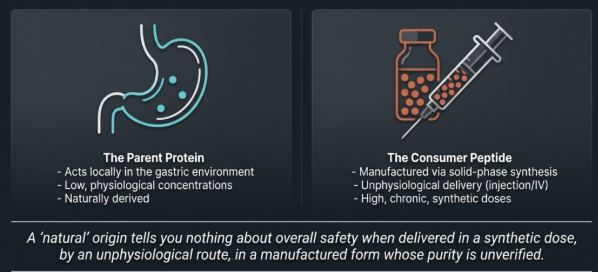
- Route of administration
- Concomitant therapies
In my experience, when dose/exposure details are vague, the claim is usually harder to interpret scientifically—even if the author means well.
3) Assess safety reporting quality
For any intervention—especially one frequently discussed outside mainstream therapeutic pathways—safety information is central. Look for adverse event reporting, lab monitoring, and whether discontinuations occurred.
Human evidence that doesn’t clearly report safety is still an evidence gap. It doesn’t justify “it’s safe” messaging, and it doesn’t support strong efficacy claims either.
4) Check whether claims match the study population
Another pattern I’ve seen: the study population doesn’t match the marketed use case. For example, participants might be healthy volunteers, or they might not represent the pathology severity or chronicity that consumers care about.
So even if there is some human research, the question becomes: does it address your specific condition and timeline?
5) Demand transparency signals
Credible research leaves a trace. You should be able to find at least:
- Study registry information (where applicable)
- Published methods and results
- Clear inclusion/exclusion criteria
- Author affiliations and disclosures
If the trace is missing or inconsistent, that points to limited evidence infrastructure—not necessarily a cover-up. And if someone claims suppression, they should provide verifiable documentation.
What you should conclude today (and what you shouldn’t)
Here’s a grounded way to hold the line between curiosity and credibility.
Reasonable conclusions
- There is insufficient proof of clinical effectiveness if the human trial base is small, not well-controlled, or not replicated.
- Mechanistic plausibility is not equivalent to human efficacy.
- Safety cannot be inferred from hype; it must come from human reporting.
What should not be concluded from an evidence gap
- “It works” for specific injuries or outcomes without robust clinical trials and endpoints.
- “It’s hidden” without verifiable indications of suppression.
- “Everyone benefits” without evidence of effect sizes, responder profiles, or subgroup outcomes.
The questions to ask next (to future-proof your decision-making)
If you’re trying to make sense of claims as new information appears, these are the most useful questions to ask the next time someone cites bpc 157 human clinical trials or implies an “entire human evidence base” supports broad benefits.
- Where is the human study design? (randomized vs. observational, comparator, blinding)
- What endpoints were measured? (pre-specified, clinically meaningful outcomes)
- What dose and route were used? (and how that maps to real-world use)
- What adverse events were reported? (and how systematically)
- Is there replication or independent verification? (not just one-off reports)
- Does the study population match the claim’s target group?
- Is the evidence being represented accurately? (no mixing preclinical and human results as if equivalent)
FAQ
Are there reliable BPC-157 human clinical trials?
Reliable human clinical trials would mean controlled, clearly described study methods with pre-specified, clinically meaningful endpoints and transparent safety reporting. When claims outpace the rigor or clarity of the human dataset, the correct interpretation is an evidence gap—not established clinical consensus.
What’s the fastest way to tell if a BPC-157 claim is credible?
Check whether the source provides human trial design details (randomization, comparator, blinding), specific endpoints, dose/route, and safety outcomes. If those fundamentals are missing or blurred, you’re likely seeing narrative persuasion rather than evidence-led medicine.
Does the lack of human trials mean there’s a cover-up?
No. A cover-up would require concrete, verifiable evidence that trials occurred at meaningful scale and results were suppressed. More commonly, limited human trial activity reflects practical research constraints and risk allocation—an evidence gap rather than proof of wrongdoing.
Conclusion: Treat the evidence like data, not like mythology
BPC-157 discussions often collapse into a binary: either “proven” or “covered up.” In my hands-on experience evaluating biomedical claims, the most accurate stance is usually simpler: the human evidence base is limited or not yet rigorous enough to justify broad efficacy conclusions. That is an evidence gap, and it’s exactly where careful questioning—trial design, endpoints, dosing, safety, and replication—does real work.
Next step: Make a one-page evidence checklist for any new claim you encounter (trial type, endpoints, dose/route, safety, replication) and only adopt strong wording when those boxes are truly filled by human clinical data.
Discussion